Writing tip ​: how to tackle the Smurfette​ principle?

it is late in my short five years career as a bookshop girl that I was introduced to the Smurfette Principle.

I clicked « send » and, just then, somehow, after two whole fridging years working on the said send manuscript, it hit me.

Did I just sent to a publisher a kid’s novel guilty of the Smurfette Principle?

Disclaimer: I mean no offense to anyone, nor do I mean to condemn anybody’s stories or ideas. You are free to be the writer, or better yet, the human being you want to be. I simply want to share what I’ve learned from my mistakes, things I think are useful to be aware of. I’m sharing writing tips here, no judgemental life lessons of any kind.

Unless for very specific reasons, I never outline my stories. I start with a character, a general plot idea, and off I go to this new world, meeting these new people. I love writing.

In the said novel I send off to publishers recently, the main character, plagued by phobias, finds herself trying to make her utterly impossible dream come true.

I re-wrote it four times. It changed a lot. Still, it was not until I send it to the first publishers on my list (no literary agent in my very small francophone corner of North America!) that I realized what I might have done.

I wasn’t sure. Ends the research about the Smurfette Principle and how to tackle it! a

A twenty years old Principle

The Smurfette Principle has been around for twenty years now. It was first introduced by Katha Pollitt in an article published in the New York Times in 1991.

Personally, it is late in my short five years career as a bookshop girl that I was introduced to the Smurfette Principle. My friend and colleague, a lover of kid’s and YA literature, also happened to be an eager feminist, way before it got back in style.

After her lunch break, one of this day shaping up to be exactly like the day before, she burst into an outraged plea against the fact that most books were still contaminated by the Smurfette Principle, in YA novels especially.

It is quite simple. Based on the Smurfs universe, where there’s only one female among a hundred male, the Smurfette Principle highlights the fact that only one female character is present among many males in a given story, whether a novel or a Hollywood movie.

(Hollywood movies and some tv series are particularly plagued by this Principle. The same can be said for the representation of First Nations, African American, Latin American, LGBTQ+, people living with a handicap, so on and so forth. But I will stay away from that burning and so fundamental topic for now.)

Smurfettes and Smurfs of the world, be Aware !

How to tackle down the Smurfette principle? Well, it is not rocket science:

by being more aware !

If we take the time to take a look back at what we are writing, like I should have done with this kid’s novel of mine, and always bear in mind that all readers are different.

As a woman writer, you would think I would have thought of that. But no! I default to the mainstream cast of characters we see everywhere.

Once the Smurfette Principale highjacked my mind, I couldn’t do anything else but go through my characters.

My hero is a girl of Asian origins. Her sidekick is male. They get help from males. The bad guy is male. She pretty much stands alone, aside from 4 chapters where she is saved by a girl… and a guy.

Mother Smurfette

Sadly, my story screams Smurfette Principle.

Now, I will follow my own exemple.

Once I am thru with the current story I’m writing, I am determined to do some serious twicking on the manuscript, whether I get a positive answer from the publishers or not.

It does mean going over the whole for the fifth time. But I’ll be dang before I end up being with my pen name on a loaded Smurfette Principle book.

Sources:

https://www.theguardian.com/film/2017/dec/11/smurfette-principle-why-cant-hollywood-accept-gender-equality

http://lesbrutes.telequebec.tv/capsule/2802

Talents Hauts et le sexisme en littérature de jeunesse

https://www.theguardian.com/books/2018/jul/27/a-depressing-lack-of-diversity-in-childrens-books
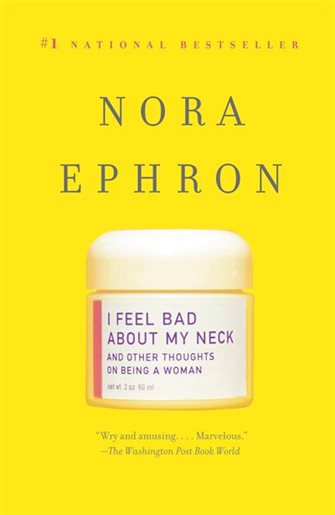
Book of the week ​: I feel bad about my neck and other thoughts about being a woman

Most of the time, great books finds me more then I find them.

Sometimes, they find me ahead of time, when I’m not entirely ready to read them. A great example would be the excellent The Luminaries by Eleanor Catton. How do I know its an excellent book if I haven’t read it yet, yet again that its a perfect book for me, you ask?

Well, because in this novel, everything is there to love! Well, for me to love anyway. Goldrush in New Zealand in the 1860′, murder and mystery, now we’re talkin’!

Fateful books

Sometimes though, thrown my way by this mysterious blow of fate, books find me at the right time. That’s what happened with this book by Nora Ephron.

I swear, I’ve been trying to remember how this non-fiction book, written by a filmmaker I otherwise adored heart&soul, in short, how I came to buy this book at the end.

It was through writing research, for sure. I spent way too much time doing writing research. Its not good to constantly researching, since it slow the writing down; plus, its sparks many story ideas.

Now you might think I’m a heartless reader when you hear what I’m about to tell you, but I will be brave.

What I like the most about non-fiction is the freedom it gives me as a reader; by freedom, I mean the freedom to skip a chapter or two without feeling a smidgen of guilt.

I feel bad about my neck and other things

After reading that book, I stopped thinking me and Nora could have written a movie together.

Her writing is quick, witty, yet thoughtful, more so, soulful. Her love of New-York makes you want to drop everything and move there. Well, move in her beautiful apartment in the East side anyway.

I did skip some chapters, since I already knew I would go back to the book in one, five, ten years.

I feel bad about my neck, by Nora Ephron, is a must have in the Want-to-read pile

How to write your first draft faster? Putting a beloved writing tip to the test!

I am a slow writer. I overthink, I over babble, I over edit. Since I decided to make a living as an traditionnaly publsihed author, I started relentlessly searching for tips and tricks to improve, well, everything about my writing. From the routine and character building to the writing pace. Everything. That is exactly what … Continuer la lecture de « How to write your first draft faster? Putting a beloved writing tip to the test! »

I am a slow writer.

I overthink, I over babble, I over edit.

Since I decided to make a living as an traditionnaly publsihed author, I started relentlessly searching for tips and tricks to improve, well, everything about my writing. From the routine and character building to the writing pace. Everything.

That is exactly what I found: every piece of advice every good willed (well, money willed too, let’s be honest here) writer can cook up about writing.

What’s a writer to do with all those tips ?

So many tips, so little time

First, I go by the zero bashing rule. I am not here to judge on condemn anybody who’s trying her or his best to help others out there.

Soon, I started to feel like a foolish unproductive amateur, although I’ve had creative writing classes in University; and I’ve been writing for twenty years; and I’ve actually started my own semi-successful little blogging in-French-an-in-English business.

Among other things, I started to think I needed to learn how to write faster if I ever wanted even a mere chance at getting traditionally published.

I stopped right there and I took a few moments to think things over.

Peer pressure, sort of

Why did I felt pressured by a bunch of people I’ve never met, to do things this-or-that way in order to achieve master the art of being a successful writing career?

Mostly because I want this to work sooo badly. I want to be able to tell my kid you can make your dream come true.

That being said, I was not going to pay hundreds of dollars to be taught how to write an cheap e-book repeating the same s***, to illustrated what I found on some blogs (I do not intend to attack anyone, you gals and guys are darn aloud to earn a living), for the sake of giving it away in order to build an audience for my own author platform. Its just not me.

That being said, I figured that some of those free tips I found might be worth a try anyway.

I choose three tips among the many, many, many writing tips about writing your first draft out there. And I put them to the test!

Carve time

Yeah, I know. How can that one event qualified as a tip, I asked myself every time I stumbled upon it. I put it to the test anyway, since it was everywhere and my writing process was still on the slow side of things.

Those great bloggers say to schedule time for writing, commit to it for at least 21 days and cut back your candy crushing time (that last one is from yours truly).

In short: clear distractions, put the kids to bed and the fiancé in front of a couple of new comic books, be consistent.

Consistency was, with self-doubt and a ton of other little icky things, a major problem for me.

I followed the obvious tip and, honestly, I wrote 23 000 words within 3 weeks. Never before, and I have been writing for 20 years, have I wrote that many words so fast.

Now, I still get up all the time to get more hot water for the tea (I truly dislike coffee, at all times, in all forms), but, I sat my butt back down on that chair and go back to it.

Here’s the authors and bloggers who helped me accomplish that :

Set realistic goals

I can do it. I also wanted to write a novel in thirty days. I wanted in.

So, I wrote a novel in a month. 50 000 words in thirty days. I did it ! Dirty little secret thought: I rewrote the thing for the next year and a half. I got up to 52 000 words and except for the names of the characters, none of those first 50 000 words written in 30 days survived.

Nevertheless, I kept coming back with unrealistic writing goals that only left me discouraged or disappointed or candy crushing my writing sorrows to oblivion.

Not healthy.

Setting realistic goals, like take a piece of paper and write them down, helped me tremendously. I was going to write 1000 words 5 night a week, get myself writing time two out of four Saturdays mornings and finish a tween novel in three months.

The first thing you know, I am ahead of schedule and I feel super proud, mainly because I set myself up to a goal way below of what I can do. I feel like I beat my highest score almost every day. Plus, I have so much more fun writing this story!

That tip helped me the most, by far.

Here’s the links to the posts that really helped:

Inner editor OFF

More then once, I spent an entire hour on ONE paragraph, or edit a chapter way to early in the process.

Something had to be done. I still struggle, but shutting off my inner editor made me able to write 23 000 words in three weeks.

I did some editing since a character got 75% deleted, some scenes changed and other rippling effects had to be delt with so the story would still make sense.

Still, by pushing through my urge to rethink everything on the spot instead of keep on writing that chapter, I got more writing done. And good writing too.

I tend to over-doubt myself, I guess. Forcing my inner editor to calm the heck down is a pretty good tip to write anything faster, truth to be told.

I edit later. The writing is improving because of it, I feel. It’s all good.

Here’s the best post about that tip:

Writing tips to the test, part two

I planned to finish the current first draft by March 31. I let you know if I was able to keep the tips going and what I found most relevant in the long run.

Let me know what you think about this writing tips test!